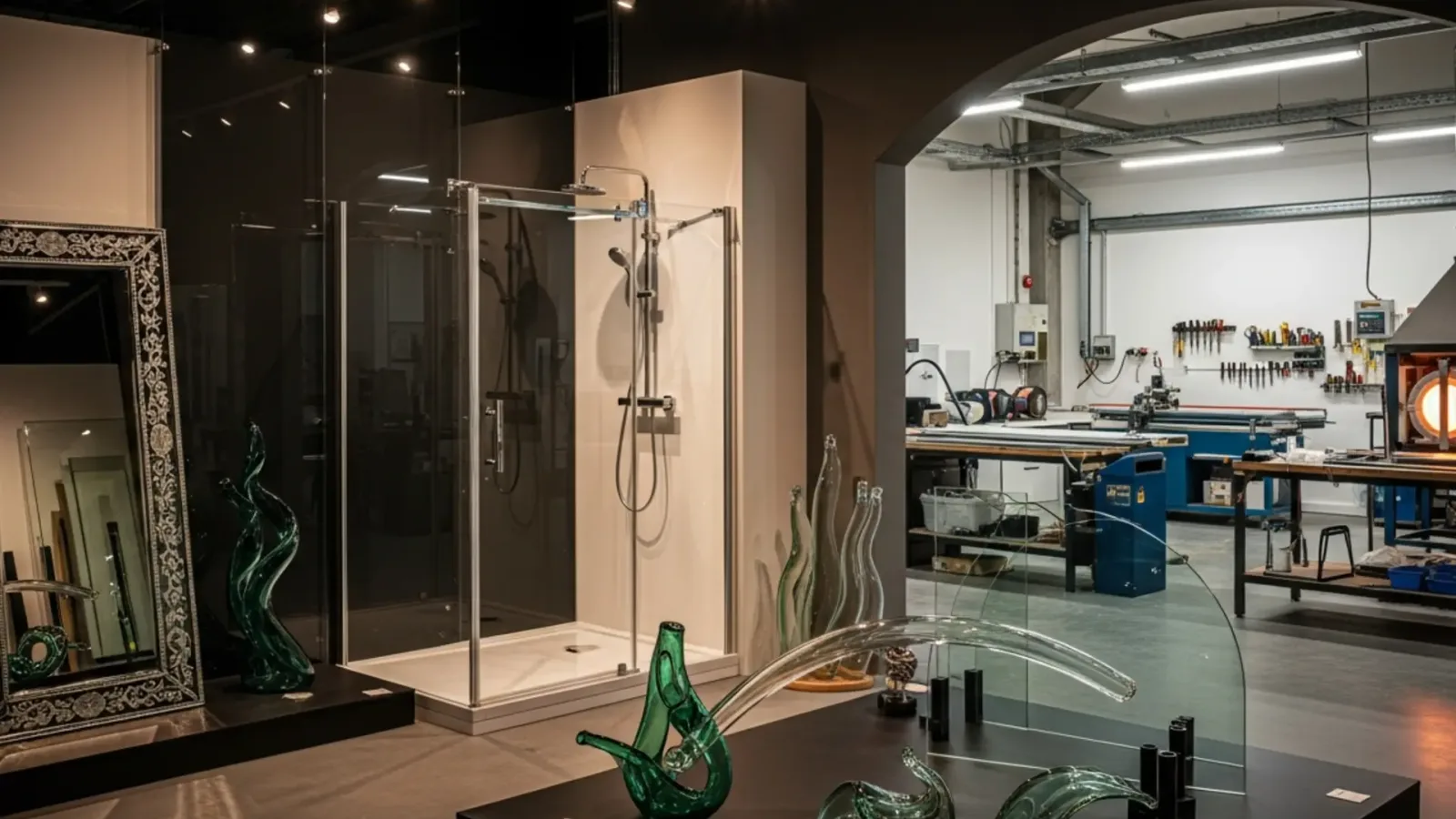
Glass hardware means the hinges, handles, connectors, clamps, profiles and sliding systems that hold a pane in place and let you operate it. It is always selected before the glass is cut and tempered, because no hole can be made in a tempered pane. Shower enclosures use spring hinges and handles, doors use rising-pivot hinges and locks, balustrades use point fixings, clamps and profiles. Durability comes from the material - stainless steel or brass - not from the colour.
What exactly is glass hardware
A fitting is any component that connects glass to the structure or to another pane, carries its weight and allows movement. In practice hardware falls into four functional groups.
- Load-bearing components - hinges, point fixings, clamps, U-profiles and connectors. They transfer the weight of the pane to the wall, ceiling or floor. They decide safety, so there is no room for savings here.
- Moving components - sliding systems, rollers, tracks, soft-close mechanisms. They work every day, a dozen or more times a day, and this is where wear appears first.
- Operating components - handles, knobs, pull bars, locks and latches. They are touched most often, so they shape the impression of quality more than anything else.
- Sealing components - vertical and bottom seals, thresholds, door stops, cover caps. They cost the least and cause the most complaints - because they are what lets water onto the floor.
Hinges - they decide how a door moves
The hinge is the most heavily loaded component of the whole installation. A pair of hinges typically carries 20 to 45 kg of door leaf, depending on the model and mounting. An 8 mm pane measuring 80 x 190 cm weighs about 30 kg - which shows that the load margin is not theoretical.
Several solutions are common in practice:
- spring hinges - with a self-closing mechanism, the standard in shower enclosures; the door returns to the closed position by itself,
- rising-pivot hinges - they lift the leaf slightly on opening, so it never scrapes the floor,
- bath screen hinges - for light bath screens and splash guards,
- frame hinges - when a glass leaf is to work inside an existing door frame,
- glass-to-glass hinges - they join two panes without using the wall.
Three things matter in the choice: the permissible leaf weight, the glass thickness (usually 6, 8 or 10 mm) and the opening angle. Plus one that is easy to forget - the cut-out pattern. Every model has its own, so changing the hinge after the glass has been ordered almost always means a new pane.
Point fixings, clamps and profiles
Where glass does not need to open but must hold - balustrades, partitions, canopies, display cases - fixed mountings are used. They fall into two families that differ in one fundamental way: whether they require a hole in the pane.
- Point fixings (rotules) - the pane hangs on pins passing through drilled holes. They give the highest load capacity and the cleanest look, but require precise hole layout before tempering. Used with 8-12 mm glass.
- Clamps - jaws grip the pane through rubber inserts without touching the glass itself. Installation is more forgiving because the position can be corrected, but capacity is lower and more fixing points are needed.
- U-profiles and base rails - the pane slides into a profile along its full length and is wedged. Typical for self-supporting balustrades without a handrail - the load spreads evenly, but the profile must be planned at the screed stage.
- Stand-off fixings - they hold the pane a few centimetres off the wall, creating a floating effect. Used for signage, information panels and guards where looks matter more than heavy loads.
Sliding systems - comfort that demands precision
Sliding doors take up no space in front of the opening - their biggest advantage. In return they demand something hinged doors do not: a straight and rigid mounting plane.
The top track must be level along its entire length. If the wall undulates, the door will drift to one side or start scraping. In a bathroom there is also the bottom guide, which keeps the leaf in line - and which collects water deposits the most.
When choosing a sliding system, check: the roller set capacity against the leaf weight, how the system is adjusted after installation, whether it has a soft-close or end damper, and how the leaf is removed for cleaning. That last point is often overlooked, yet it decides everyday comfort.
Seals, thresholds and accessories - the cheapest part, the biggest trouble
These are the items at the bottom of the quotation, often crossed out when negotiating the price. And then they generate the most phone calls after installation.
- Vertical seals - mounted on the door edge and where it meets the fixed panel. Magnetic versions also pull the leaf shut and quieten the closing. They are consumables - they harden after a few years and get replaced, so choose a system where they are sold separately.
- Bottom seals with a drip rail - they direct water running down the pane back into the tray. Without them water lands on the grout, and after a year you can see it on the floor. Their profile is matched to the gap above the tray, not chosen "universally".
- Thresholds and floor rails - they guide the bottom edge of the pane and close the gap. In walk-in enclosures the threshold is sometimes the only thing holding the panel, so its fixing must be planned before the tiles are laid.
- Door stops, caps, towel hooks - a stop protects the glass edge from hitting the wall, and every such impact on a tempered pane is a risk. Caps mask the fixings; towel hooks mount in holes that also have to be made before tempering.
Locks, latches and all-glass partitions
Glass doors for offices and commercial premises add a group of hardware a bathroom does not have: locks and latches. They mount in a cut-out in the pane or in top and bottom rails, and the chosen model dictates the shape of that cut-out.
All-glass partitions - where the whole wall is glass and the door is part of it - also need profiles joining top and side lights, and glass-to-glass connectors working at 90 or 180 degrees. These elements must be drawn up together, because tolerances add up along the whole partition. With a three-pane wall, a two-millimetre error at each joint gives six millimetres of play at the end.
That is also why all-glass partitions are measured after finishing work is complete, not at the bare-wall stage.
Material and finish - what really decides durability
The colour of hardware is chosen with the eyes, but durability depends on what is underneath the coating.
- Stainless steel AISI 304 - interiors, bathrooms, partitions; with high chloride exposure pitting corrosion can appear.
- Stainless steel AISI 316 - pools, spa areas, facades; pricier, but more resistant thanks to added molybdenum.
- Brass - hinges, handles, decorative parts; softer than steel, needs a solid coating.
- Aluminium - profiles, tracks, rails; light and inexpensive, but not for heavily loaded parts.
- Zinc die-cast - cheap substitutes; can crack under load - we avoid it in load-bearing components.
The coating is a separate matter. Modern PVD finishes fuse the colour into the surface in a vacuum process and resist scratching. Cheap galvanic plating dulls and chips over time - usually exactly where it is touched most.
The decision point: what must be settled before tempering
This is the most important section of this guide. Once tempered glass leaves the furnace it is in its final state - it cannot be cut, drilled or ground. Any attempt shatters the whole pane.
So before a pane is sent for processing, the following must be known: the exact hardware model, the glass thickness, the side and direction of opening, the hole pattern, the edge finish and the type of glass itself. If any of these points is still open, we hold off cutting - it works out cheaper.
Five mistakes that cost the most
- 1. Hardware chosen after ordering the glass. The classic, and the most expensive mistake. The customer buys a handle at a DIY store, brings it to the workshop - and its hole pattern does not match the pane. The glass has to be replaced.
- 2. Cheap hardware on expensive glass. A tempered pane worth hundreds paired with zinc die-cast hinges is a saving that comes back within a year as a sagging door. Hardware is usually 20-30% of the installation value yet causes most of the faults.
- 3. Mixing finishes in one room. A chrome hinge next to a black tap and a gold handle. Each part may be fine on its own; together they look accidental.
- 4. Skipping seals and the threshold. The cheapest items of the set - and without them water ends up on the floor. Seals are consumables replaced every few years, so pick a system where they are available separately.
- 5. Wall mounting without checking the substrate. A hinge carrying 40 kg screwed into unreinforced plasterboard will pull out sooner or later. The substrate must be established at measurement time, not on installation day.
How much does glass hardware cost
Prices depend on the system and finish, but the proportions in an order are fairly repeatable. In a typical shower enclosure the complete hardware set is usually 20-30% of the whole installation. In a balustrade with a base profile the share can be higher, because the profile and its fixing cost more than the pane. In a glass door with a lock and door closer, hardware can equal the price of the glass.
Three things drive the price: the base material (stainless steel costs more than zinc die-cast), the coating type (PVD more than plain galvanic) and whether the set includes a mechanism - spring, soft-close, damper. Colour alone raises the price moderately, though rarer finishes such as copper or brushed graphite can cost more than classic chrome.
Our advice after years of installations is simple: if the budget is tight, it is cheaper to go down a class in finish than in mechanism. A chrome hinge instead of matt black works just as well. A hinge in cheaper die-cast instead of steel - it does not.
How we order glass together with hardware
Since 1992 we have been making glass partitions, shower enclosures, balustrades and mirrors in Szczecinek, Poland. We select hardware together with the glass, from proven suppliers, and we take responsibility for one fitting the other.
- we arrange a measurement or accept dimensions when the location is typical,
- we settle the opening method, glass thickness and hardware model - in one conversation,
- we prepare the pane with all cut-outs made and tempered,
- we install the complete set and adjust the hinges on site.
The advantage of a single contractor is that there is no argument about whose fault it is when something does not fit.
Frequently asked questions
What is glass hardware?
All the components that hold a glass pane in place and let you operate it: hinges, point fixings, clamps, profiles, connectors, sliding systems, locks, thresholds and seals. They are always chosen together with the glass, because the hardware model determines the position of every hole and cut-out in the pane.
Why does hardware have to be chosen before ordering the glass?
Because every hole and cut-out must be made before tempering. Nothing can be drilled or cut in a tempered pane - any attempt shatters it. Changing the hardware model after the glass has been ordered means, in practice, a new pane.
How much weight do glass hinges carry?
Depending on the model, a pair of hinges typically carries 20 to 45 kg of door leaf. A tempered 8 mm pane measuring 80 x 190 cm weighs about 30 kg, so matching the hinge to the glass weight is not a formality - it is a safety requirement.
What is the difference between a point fixing and a clamp?
A point fixing passes through a hole in the glass and offers high load capacity, but requires the holes to be planned precisely before tempering. A clamp grips the pane through rubber gaskets, needs no hole and forgives small corrections on site, but carries lower loads.
What hardware is best for a bathroom?
Preferably stainless steel, and in humid, chemical-heavy environments a grade with higher chloride resistance. PVD finishes withstand moisture and cleaning far better than cheap galvanic coatings, which dull and chip over time.
What share of the total cost does hardware take?
Usually 20-30% of the whole installation, depending on the system and finish. That is much less than the glass with processing and installation - yet hardware causes most of the faults, which is why saving on this item pays off the least.
Can hardware be replaced in an existing installation?
Sometimes, provided the new model has an identical hole pattern or is a clamp type. Switching to a system that needs different cut-outs means a new pane. That is why we always ask for a photo and dimensions of the existing fitting.