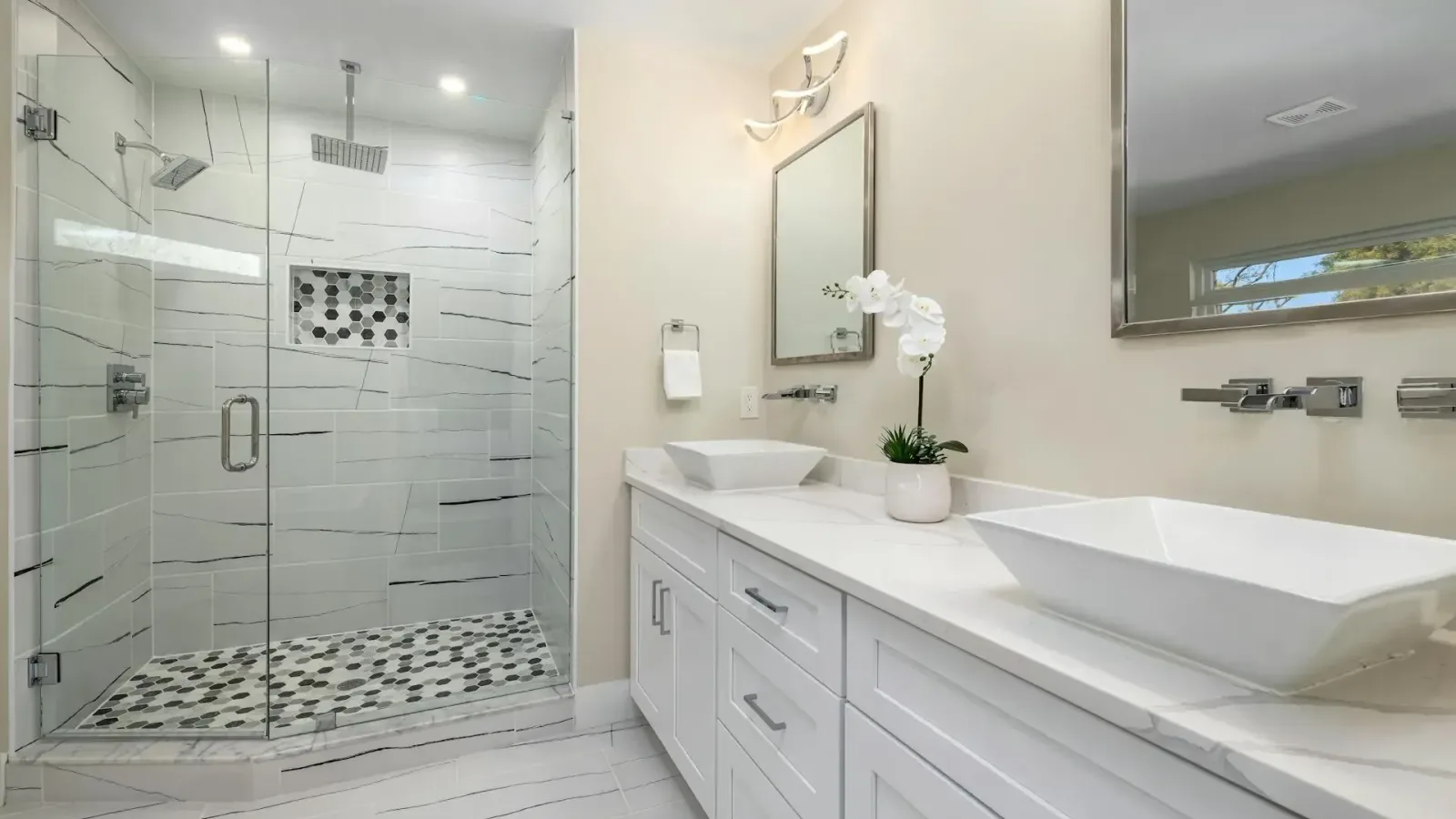
Glass hardware now comes in over a dozen finishes - from classic chrome and brushed steel, through matt black and white, to gold, graphite (gun metal) and brushed copper. The colour is matched to the tap and shower head, not to the tiles, because the fittings sit closest to the glass. Durability, however, comes not from the shade but from the material and how it was applied: PVD coatings on stainless steel withstand moisture and cleaning far better than cheap galvanic plating, which dulls and chips over time.
Rule one: the colour is matched to the tap
The most common mistake is matching hardware to the tiles. It feels intuitive, but leads astray - tiles are the background, not the point of reference.
The point of reference is the metal already in the bathroom: the tap, the shower head, the spout, the linear drain, the towel rail. The enclosure hardware sits right next to them and forms a pair seen in a single glance. If the tap is chrome and the hinges are black, the eye catches it instantly - no matter how well the tiles are chosen.
Hence the rule we repeat at every quotation: one metal per room. Deliberately mixing two finishes can be striking, but it is a move for people who know what they are doing - and it works best when one metal clearly dominates and the other appears in a single accent.
Finishes overview - what goes with what
- Polished chrome - the classic, most available and cheapest. It fits most taps, since chrome is still the most popular fitting finish. Downside: it shows every water drop and fingerprint, so hard-water bathrooms mean frequent wiping.
- Brushed steel - matt, warm in feel and much more forgiving of water marks than chrome. Excellent in loft and Scandinavian styling. Our most recommended choice for families with children - it simply shows less.
- Matt black - the strongest trend of recent years. It looks great against light tiles and with dark grout. But it demands consistency: a black enclosure next to a chrome tap is the most common mistake we see in recent renovations.
- Brushed graphite (gun metal) - dark but not black, with a light metallic sheen. Softer than matt black, it pairs well with concrete, wood and warm minimalism. A rarer finish, so it can cost more and matching all components can be harder.
- Polished and brushed gold - polished gold is a bold glamour accent that works on dark tiles. Brushed gold is subdued and versatile - it looks great in bright interiors with white and wood. One condition: the tap must be in the same shade, and gold tones differ between manufacturers.
- Brushed copper and matt white - copper is a brave pick, beautifully paired with terracotta, wood and retro styling. Matt white works the other way round - the hardware disappears against white walls and tiles, which is welcome when the glass is meant to be the only accent.
Rule two: colour is a coating, durability is a material
Here begins the part that internet photos do not tell you. Two fittings in identical matt black can differ in lifespan by years - because underneath the coating there is something completely different.
- Stainless steel AISI 304 is the indoor standard. It handles moisture well, but high chloride exposure can cause pitting corrosion.
- Steel AISI 316 contains molybdenum and is clearly more resistant - the choice for spa areas, pools and outdoor use.
- PVD coating is applied in a vacuum and fuses into the surface. It is hard, scratch-resistant and does not chip - which is why good coloured hardware is made in this technology.
- Galvanic plating is much cheaper, and it is what usually shows its age: it dulls, then starts chipping at the edges, typically where touched most.
- Powder coating gives a beautiful, deep matt black or white, but is more sensitive to impacts - a knocked spot shows immediately and cannot be touched up.
The practical conclusion: if the budget is limited, it is better to go down a class in colour than in material. A steel fitting in chrome will outlive the bathroom. A showy matt black on a cheap casting - not necessarily.
How coloured hardware behaves day to day
Aesthetics is one thing, daily cleaning another. Years of installations have taught us a few regularities worth knowing before you choose.
- Polished chrome - water marks highly visible; every drop leaves a trace, but it cleans easily.
- Brushed steel - low visibility; the texture masks marks, wipe along the grain.
- Matt black - medium; hard-water deposits show, needs a soft cloth.
- Brushed graphite - low; one of the most practical finishes.
- Gold - medium; avoid abrasives, which dull the coating.
- Brushed copper - low; the shade can change over time - for some customers that is a plus.
One note regardless of colour: no abrasive creams and no acid-based cleaners. Most of the ruined coatings we have seen were not the work of years, but of an aggressive descaler used once a month.
Hardware colour and the type of glass
There is one more dependency that is easy to miss: dark hardware exposes the tint of the glass. Ordinary float glass has a slight greenish hue, clearly visible at the edge of the pane. With chrome hardware nobody notices. With black profiles and light tiles, the green edge suddenly becomes part of the composition.
That is why in projects with black or graphite hardware and a bright bathroom we increasingly propose low-iron glass, which is practically colourless.
The same applies to mirrors and lacquered glass: white lacquer on ordinary float has a slightly creamy-green tone that stops matching next to white matt hardware.
Four mistakes when choosing a colour
- 1. Picking the colour from a phone screen. Brushed gold in a photo and in reality can be two different colours. Shades also differ between manufacturers - which is why we always show a physical sample before ordering.
- 2. Colour chosen after ordering the glass. A change of finish usually means a different hardware model, and a different model means a different hole pattern. In tempered glass the holes cannot be moved - see our guide Glass hardware.
- 3. A rare finish without checking availability. With copper or graphite it happens that not all components of a set come in the same shade. We check set completeness before accepting an order, not during installation.
- 4. A fashionable colour without thinking ten years ahead. An enclosure is replaced less often than towels. Ask yourself whether the chosen shade will still please you when it stops being fashionable - and whether it will match the tap you will one day replace.
How we match finishes
At every quotation for an enclosure, balustrade or partition we ask two things: what the tap looks like and what other metal elements are in the room. On that basis we propose a finish that will work with them - and we say openly when a chosen colour will clash with the fittings.
We also show physical samples - the only way to judge a shade in the light in which the fitting will actually be seen. Photos fail at this job.
Frequently asked questions
What colours does glass hardware come in?
The most popular are polished chrome and brushed steel, alongside matt black, matt white, brushed graphite (gun metal), polished gold, brushed gold, antique gold and brushed copper. Availability varies between set components, so completeness is checked before ordering.
Should hardware colour match the tiles or the tap?
The tap and the rest of the fittings. They sit closest to the glass and form a pair seen in one glance. Tiles are the background. The most common mistake in freshly renovated bathrooms is black enclosure hardware next to a chrome tap.
Is black hardware durable?
It depends on how the colour was applied. Matt black as a PVD coating on stainless steel is hard and scratch-resistant. The same colour as powder coating on a cheap casting looks similar in the shop, but takes impacts worse and shows wear after years.
What is the difference between PVD and galvanic coating?
PVD is applied in a vacuum and the colour fuses into the surface, creating a hard, scratch-resistant layer. Galvanic plating is cheaper and thinner - over time it dulls and starts chipping at the edges, usually where touched most.
Which finish is easiest to maintain?
Brushed steel and brushed graphite - the matt texture masks water marks and fingerprints. The most demanding is polished chrome, which shows every drop, though it cleans easily. Whatever the colour, avoid abrasive creams and acid-based cleaners.
Does black hardware need special glass?
It is not required, but worth considering. Dark hardware and light tiles emphasise the greenish tint of the edge of ordinary float glass. In such projects we often suggest low-iron glass, which is practically colourless.
Can two hardware colours be mixed in one bathroom?
Yes, but deliberately. It works best when one metal clearly dominates and the other appears as a single accent, for example in the handle. An accidental mix of three different finishes always looks unfinished.
Can the hardware colour be changed after ordering the glass?
Usually not without replacing the pane. A different finish usually means a different hardware model, and a different model means a different hole pattern. Holes in tempered glass cannot be moved, so we settle the colour before cutting and tempering.