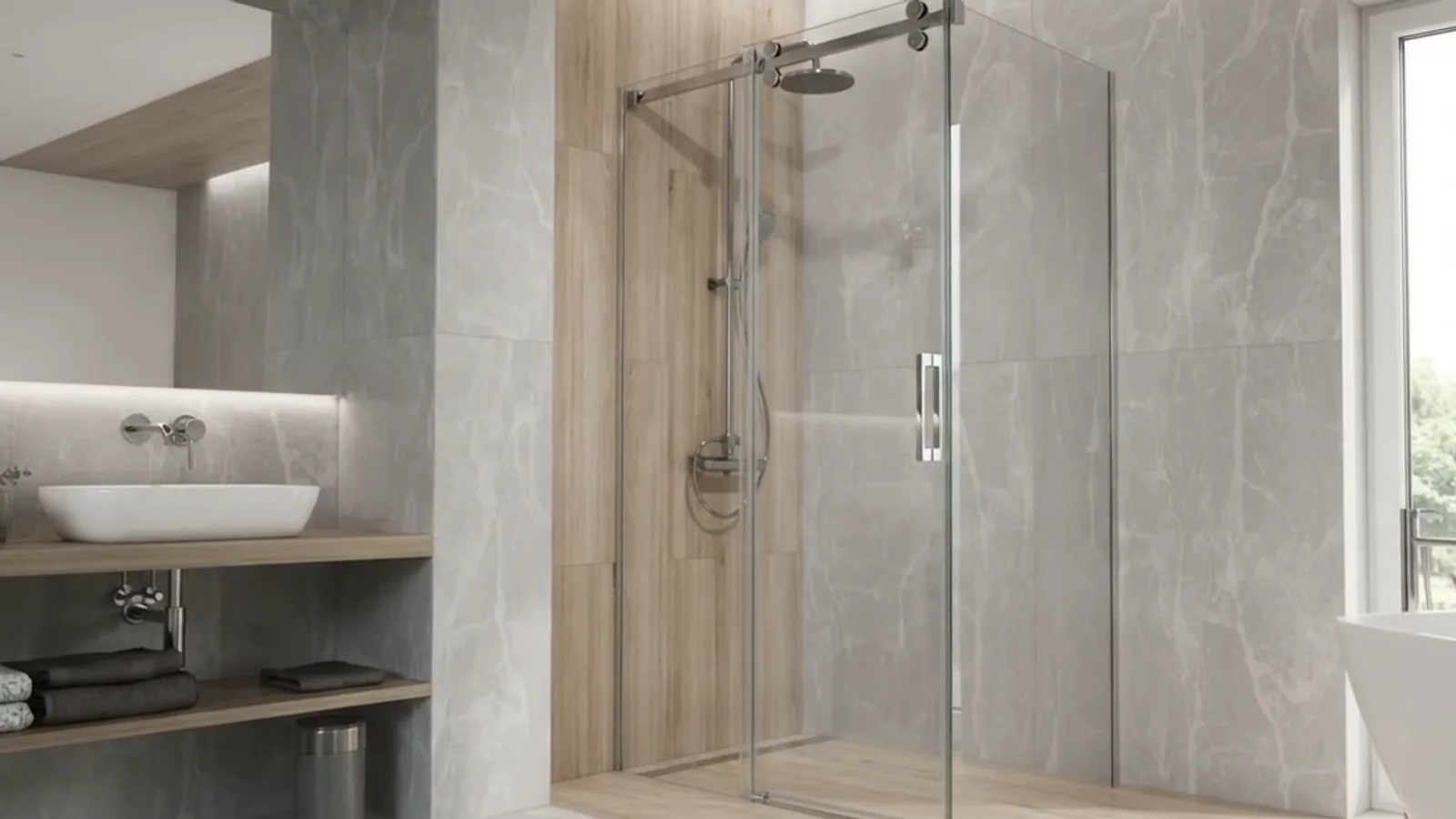
A shower enclosure needs a complete set: hinges (spring hinges for pivot doors, a roller system for sliding ones), a handle or knob, a stabiliser bar for the fixed panel, vertical seals plus a bottom seal with a drip rail, and a threshold. The standard is tempered glass of 6 or 8 mm - a pair of hinges typically carries 20-45 kg, so the choice depends on the leaf weight. All cut-outs and holes must be made before tempering, which is why hardware is chosen together with the glass, never after it.
First the opening method, then the glass
Every conversation about an enclosure starts here. Three solutions mean three different hardware sets and three different demands on the bathroom.
- Pivot door - the most common and cheapest solution. It needs room for the leaf to swing - usually 60-80 cm of free space in front of the enclosure. Set: a pair of spring hinges, a handle or knob, a magnetic seal at the closing edge and a bottom seal.
- Sliding door - takes no space in front, so it works in small bathrooms. Set: a top roller system, bottom guide, end stops, seals. It requires a straight and rigid plane for the track.
- Walk-in - one large pane, no door. The simplest set - a floor profile, a stabiliser to the wall or ceiling, a bottom seal - but it needs a bigger tray or a sloped floor with a linear drain.
- Bath screen - a category of its own: a light 6 mm pane on bath screen hinges, often folding. Less weight means lighter hardware, but also less tolerance for impacts.
Hinges - the most loaded part of the enclosure
Hinges carry the whole weight of the leaf and work a dozen times a day for years. They decide whether the door still closes by itself after three seasons.
The key number is the permissible leaf weight. Depending on the model, a pair of hinges carries from about 20 kg (light and rail versions) to about 45 kg (glass-to-glass and reinforced versions). For orientation: a tempered 8 mm pane of 70 x 190 cm weighs about 26 kg, and 80 x 200 cm already over 31 kg. The load margin should be real, not borderline.
The second thing is the mechanism type:
- spring hinges - they close the door by themselves within the last dozen or so degrees, so the leaf never stays ajar,
- rising-pivot hinges - they lift the leaf a few millimetres on opening, protecting the seal and the floor,
- angle-adjustable hinges - they allow correction after installation, a lifesaver with uneven walls,
- glass-to-glass hinges - they join the door directly to the fixed panel, without using the wall.
Third, and most often overlooked: the cut-out pattern in the pane. Every model has its own layout, and a cut-out in tempered glass is final. That is why we settle the hinge model before the glass is cut - more on this in our guide Glass hardware - how to choose it.
Handle, knob, pull bar - the part you touch every day
The handle is the only part of the enclosure the user touches several times a day. That is why it builds - or ruins - the impression of quality more than anything else.
Three things are worth checking. First, the mounting: double-sided handles need two through-holes in the pane, single-sided knobs need one. Second, the material: brass and stainless steel beat zinc die-cast, which can crack at the thread after a few years. Third, the shape - a full-height ladder handle looks striking but collects more water deposits than a simple knob.
In sliding enclosures the handle is often integrated with the guide, so it is chosen together with the system, not separately.
The stabiliser - the bar that saves a large pane
A fixed panel wider than roughly 90 cm starts to work - it vibrates slightly when the door closes and during cleaning. The stabiliser, a bracing bar between the pane and the wall or ceiling, stiffens the structure and eliminates that movement.
It comes in several variants: wall-to-glass (most common), glass-to-glass at 90 degrees, and ceiling-to-glass for free-standing walk-in panels. The glass fixing is either clamped or through a hole - and here the same rule returns: the hole must be made before tempering.
In walk-in enclosures the stabiliser is not an add-on but a structural element. Without it a large free-standing pane has no right to stand safely.
Seals and the threshold, or why the water is on the floor
This is the cheapest part of the order and, at the same time, the most common reason for a phone call after installation. It helps to know what does what.
- Magnetic seal - mounted on the vertical door edge where it meets the fixed panel. It pulls the leaf shut and quietens the closing. Double-door enclosures use a pair of magnetic seals meeting each other.
- Wall seal - fills the gap between the pane and the wall. Its profile is matched to the actual gap, because walls are rarely straight - hence the few-millimetre tolerances in most systems.
- Bottom seal with drip rail - directs water running down the glass back into the tray. It usually decides whether the floor in front of the enclosure stays dry. It wears out and is replaced after a few years.
- Threshold and bottom rail - guides the bottom edge of the pane, closes the gap and, on walk-ins, transfers the load to the floor. Its fixing must be planned before tiling, because later it means drilling through the finished surface.
A practical tip: when ordering, ask whether the seals are available separately as spare parts. Systems where you cannot buy just the seal force you into replacing a bigger set after a few years.
Which glass and what thickness for an enclosure
The standard is tempered glass. Not because it is the strongest in every sense, but because when it does break it crumbles into small, blunt granules instead of sharp shards. An enclosure does not protect against falls from height, so laminated glass is not needed here.
- 6 mm - bath screens, small leaves, fixed panels up to 80 cm; lighter, cheaper, with lighter hardware.
- 8 mm - typical enclosures, doors and fixed panels; the most common choice and a good compromise.
- 10 mm - large walk-in panels and wide leaves; heavy - it needs stronger hinges and a solid substrate.
A separate decision is the tint of the glass. In bright bathrooms with white tiles the greenish hue of ordinary glass can show at the edge of the pane - the alternative is low-iron glass.
Four mistakes we see most often
- 1. Buying hardware separately, after ordering the glass. A handle bought at a DIY store almost never fits holes cut for a different model. In tempered glass they cannot be moved.
- 2. Measuring before the bathroom is finished. An enclosure is measured after the tiles are laid and the tray installed. A measurement on bare walls always drifts by several to a dozen millimetres.
- 3. Hinges too weak for a heavy pane. A leaf of 80 x 200 cm in 8 mm weighs over 30 kg. Hinges rated at 20 kg will last a few months, then the door starts to sag and scrape.
- 4. No reinforcement in the wall. With plasterboard walls, the hinge mounting area must be reinforced. We establish this at measurement time, because on installation day it is already too late.
What to prepare before ordering an enclosure
We have been making made-to-measure enclosures in Szczecinek, Poland since 1992 - together with hardware, tempering and installation. For a binding quotation we need:
- the recess or tray dimensions in millimetres, measured at three points,
- the opening method and how much space there is in front of the enclosure,
- the substrate at the fixing points (masonry, plasterboard, tiles on adhesive),
- the preferred hardware finish - we match it to the tap and shower head,
- a photo of the bathroom if the layout is unusual.
With unusual recesses we prefer to come and measure ourselves - it takes well under an hour and saves the cost of a new pane.
Frequently asked questions
What hardware does a shower enclosure need?
The basic set is hinges or a sliding system, a handle or knob, a stabiliser bar for the fixed panel, vertical seals plus a bottom seal with a drip rail, and a threshold. Add the small parts: a door stop protecting the glass edge and caps masking the fixings.
Which hinges should I choose for a shower enclosure?
For pivot doors the usual choice is spring hinges, which pull the leaf shut by themselves. The key parameter is the permissible weight: a pair of hinges carries 20 to 45 kg depending on the model. A leaf of 80 x 200 cm in 8 mm glass weighs over 30 kg, so light-duty hinges are out.
What glass thickness for a shower enclosure?
Most often 8 mm - a good compromise between stiffness and weight. 6 mm works for bath screens and small leaves, 10 mm for large walk-in panels, though it needs stronger hardware and a solid substrate.
What is the stabiliser bar for?
It stiffens the fixed panel, which above roughly 90 cm of width starts to vibrate when the door closes and during cleaning. In walk-in enclosures the stabiliser is not an accessory but a structural element - without it a free-standing pane cannot stand safely.
Why does water leak out of the enclosure?
The most common causes: a worn or badly matched bottom seal with drip rail, no threshold on a walk-in, or a wall seal whose profile does not match the actual gap. Seals are consumables and get replaced every few years.
Can hardware be chosen after ordering the glass?
No. The cut-outs for hinges and the holes for the handle must be made before tempering, and every hardware model has its own pattern. A handle bought separately almost never fits existing holes, and in tempered glass the holes cannot be moved.
When should a shower enclosure be measured?
After the tiles are laid and the tray installed, never on bare walls. Measure the recess at three heights, because walls are rarely parallel - differences of a dozen millimetres are normal and the hardware system must compensate for them.
Pivot or sliding enclosure - which is better?
A pivot door is cheaper and easier to maintain, but needs 60-80 cm of free space in front. A sliding door takes no space, so it wins in small bathrooms, but requires a straight mounting plane for the track and regular cleaning of the bottom guide.